

Mynced: Business Growth Platform With ROI, Setup, and Privacy Controls
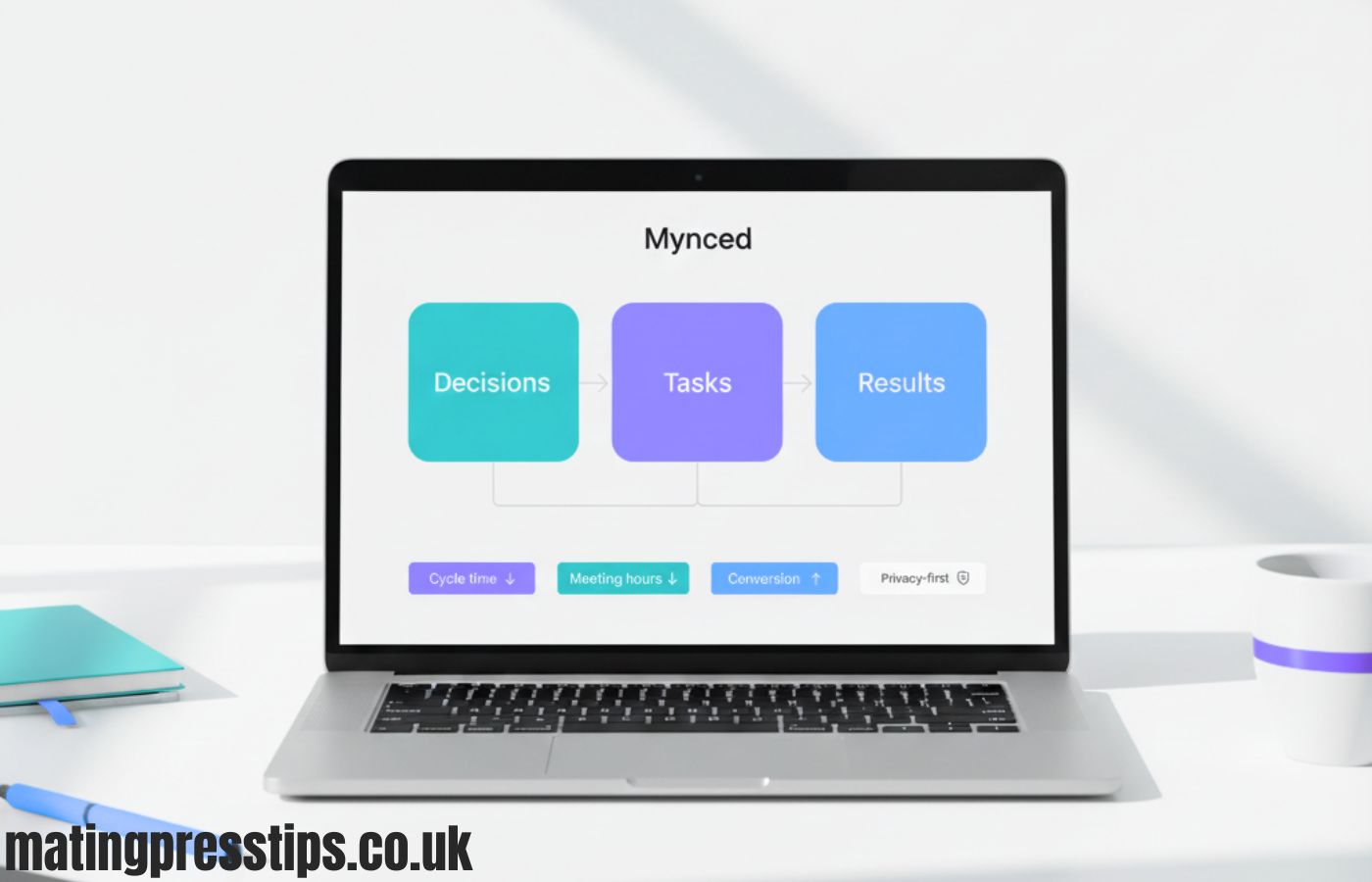
Mynced helps business growth by cutting coordination waste and improving personalization. It wins when it becomes the one place your team records decisions, assigns work, and keeps the latest files—while using minimal intent data to personalize responsibly.
If you feel “busy” but not “fast,” your bottleneck is probably not talent. It is handoffs, tool-switching, and missing context. Mynced targets those leaks by centralizing execution, so fewer tasks stall and fewer customers fall through cracks.
Do not expect magic. Expect math. You should see changes in cycle time, meeting hours, rework, and one customer KPI like conversion rate or churn. If those numbers do not move in a pilot, the tool is not the problem—your rollout is.
This page gives you a buyer-grade plan: what Mynced is, who it fits, how to implement it in 14 days, how to measure ROI, where rollouts break, and how to handle privacy and ethics with controls people can actually enforce.
What Mynced is and what it is not
Mynced is a centralized operating layer for work execution and personalization. It aims to keep context connected: discussions, decisions, tasks, and files stay in one place instead of scattering across Slack, Microsoft Teams, email, shared drives, and a separate tracker.
Mynced is not a substitute for leadership, clean processes, or accountability. If your team avoids owners and deadlines, the platform will only make that avoidance easier to spot.
If your organization already runs smoothly inside Microsoft 365 or Google Workspace with strong rules, you may not need another platform. Mynced makes sense when tool sprawl and context loss cost you real time and real revenue.
 Who Mynced is for and who should skip it
Mynced fits teams that collaborate heavily and ship work through handoffs.
Good fit if you hear these weekly:
-
“Which file is the latest?”
-
“I didn’t see that update.”
-
“Who owns this?”
-
“We decided that in a call… I think.”
Bad fit if:
-
One suite already works well and adoption is strong
-
You need deep engineering workflows first (Jira at scale, heavy CI/CD)
-
You cannot enforce simple rules (naming, ownership, decision logging)
-
Nobody can own rollout and governance for 30 days
Mynced rewards discipline. If you want “install and forget,” pick something else or fix operations first.

What ROI looks like for Mynced in real life
Forget vague “productivity.” Track blunt signals that tie to growth.
Internal execution KPIs
-
Cycle time: request → done (median, not average)
-
Meeting hours: per person per week
-
Rework: tasks reopened or revised due to missing context
-
Pings per task: “status?” messages and follow-ups
Customer KPIs
-
Conversion rate (lead → customer)
-
Churn or renewal rate
-
Support resolution time and repeat tickets
If those do not improve in two weeks for a pilot team, you did not “fail at Mynced.” You ran a pilot with weak governance, wrong workflow choice, or no measurement baseline.
Feature-to-outcome map (featured table)
| What you standardize in Mynced | What changes day-to-day | KPI that should move |
|---|---|---|
| Decisions written in one thread | Fewer re-decisions and rework | Cycle time, rework |
| Tasks always have an owner/date | Fewer dropped handoffs | Cycle time, throughput |
| Files attached to tasks/decisions | Fewer “latest version” hunts | Rework, meeting hours |
| Searchable updates replace status meetings | Less coordination overhead | Meeting hours, pings/task |
| Minimal, consent-based personalization | More relevant journeys | Conversion, churn |
The Mynced operating model (how work should flow)
Most teams do not need more channels. They need a clean work path:
-
A request appears (customer need, internal ask, ticket, lead)
-
A decision gets written (one sentence)
-
A task gets assigned (owner + due date + definition of done)
-
Assets attach to the task (file, link, notes, approvals)
-
Updates stay in the same thread (no scavenger hunt)
-
Close-out records what shipped and what changed
This flow works because it keeps context connected. It breaks when teams discuss work but avoid committing owners and dates. If that happens, enforce one rule: “No decision without a summary line, no task without an owner.”
 AI and personalization that works without creepy data
Personalization helps when it uses intent signals the user would expect. It harms trust when it feels like surveillance.
Start with minimal signals
-
Pages viewed and actions taken
-
Lifecycle stage (new, active, at-risk)
-
Support history and resolution outcomes
-
Channel preference (email, SMS, in-app)
Avoid high-risk behavior
-
Collecting sensitive data you do not need
-
Personalization users cannot understand
-
Aggressive targeting that feels manipulative
Practical examples
-
Onboarding steps based on role and goals
-
Content recommendations based on recent behavior
-
Support routing based on issue type and history
-
Renewal messaging triggered by engagement drops
If your data quality is uneven, rules beat AI. Use simple segmentation first, then add machine learning later when you can explain outcomes.
How to implement Mynced in 14 days (steps)
-
Pick one team with real work (not a demo group).
-
Pick one workflow (delivery, onboarding, support, renewal).
-
Set a baseline KPI in week 1 (cycle time + one customer KPI).
-
Define three rules: where decisions live, where files live, how tasks get created.
-
Set identity and access basics: SSO and MFA if available, roles, permissions.
-
Migrate only active work and current templates.
-
Train using one real scenario end-to-end.
-
Review adoption weekly and remove workspace sprawl.
-
Expand only after KPIs improve and rules stick.
If you migrate everything, you flood the system with junk and kill trust. People do not resist “change.” They resist chaos.
 What breaks Mynced rollouts (and how to prevent it)
Optional usage
People keep Slack/Teams/email as the “real place” for urgent work. Mynced becomes a second inbox. Fix this by making one location the default for decisions and tasks.
No governance
Channels multiply, naming gets sloppy, and search fails. Fix this with naming rules, archiving rules, and one owner who cleans up weekly for the first month.
Bad inputs
Tags and fields drift, personalization gets noisy, automation misfires. Fix this by limiting inputs, standardizing fields, and starting with rules-based flows.
Over-personalization
Users feel watched and disengage. Fix this by minimizing data, being transparent, and prioritizing usefulness over cleverness.
Privacy and ethics, written as controls
You do not “care about privacy” with a paragraph. You prove it with controls.
Controls checklist
-
Consent and clear opt-out where required
-
Data minimization (collect only what the workflow needs)
-
Purpose limitation (no surprise reuse)
-
Retention and deletion rules (enforced, not promised)
-
Access control (roles, least privilege, MFA, SSO)
-
Audit logs for admin access and sensitive actions
-
Vendor risk review (subprocessors, incident response, security posture)
-
Bias checks for personalization outcomes
If you operate in regulated environments, align controls with expectations tied to GDPR, CCPA, and common assurance targets like SOC 2 or ISO 27001.
Mynced pricing: evaluate value without making up numbers
If you do not have confirmed pricing tiers, do not guess. Rank with a buyer method.
Total cost of ownership
-
Licenses
-
Onboarding time (training hours × loaded cost)
-
Migration time (admin + team time)
-
Ongoing governance and admin time
-
Disruption cost during rollout
Break-even model
-
Time saved per employee per week
-
Meeting hours reduced
-
Conversion lift from better relevance
-
Churn reduced from better retention
If you cannot measure lift, you cannot justify a platform decision. That is not cynicism. That is procurement.

Mynced vs alternatives
Choose Mynced if
-
Execution is slow because context is scattered
-
You can enforce workflow rules and governance
-
You want ROI from coordination + personalization
Choose suite-first (Microsoft 365 or Google Workspace) if
-
Your org already lives there with strong adoption
-
You need tight admin controls and standardized identity
Choose best-of-breed (Slack + Zoom + Jira/Trello) if
-
You need specialized depth and heavy integrations
-
Different teams require different operating models
Tools do not fix disorder. Operating rules do.
Success Stories: Realistic Mynced Wins
You do not need exaggerated testimonials to understand where Mynced tends to produce results. The strongest “success stories” follow the same pattern: one workflow gets standardized, context stops scattering, and KPIs move because work stops stalling.
Success story 1: Sales-to-Delivery Handoff Stops Dropping the Ball
A growing team struggles with handoffs. Sales closes deals in one place, delivery works in another, and key details live in calls and scattered notes. Work starts late because delivery has to re-ask basic questions.
With Mynced, the handoff becomes a single thread with a decision summary, an assigned owner, and attached assets (scope, timeline, key contacts, deliverables). Delivery starts faster, fewer details get lost, and the handoff stops depending on memory.
What improves: faster cycle time, fewer internal pings, fewer “what did we promise?” escalations.
Success story 2: Client Delivery Becomes Predictable Instead of Chaotic
An agency or service team runs multiple projects at once. Updates live in chat, files live in drives, and “latest version” becomes a weekly argument.
With Mynced, each client project uses a consistent workspace structure: the plan, the files, approvals, and tasks stay attached to the same workstream. Status updates become asynchronous and searchable, so meetings stop being the only place decisions happen.
What improves: fewer revisions, fewer missed approvals, reduced meeting load, better on-time delivery.
 Success story 3: Support Gets Faster Because Context Shows Up With the Ticket
Support teams waste time because every issue starts from zero. The user repeats their story, agents hunt for history, and routing is inconsistent.
With Mynced, support requests attach to the user context and the relevant history. Routing rules send issues to the right owner faster, and responses become more consistent because prior outcomes are visible.
What improves: faster first response, faster resolution, fewer repeat tickets, higher customer satisfaction.
Success story 4: Personalization Increases Conversion Without Feeling “Creepy”
A business wants better conversion but does not want to over-collect data. They start simple: personalize onboarding steps based on role, lifecycle stage, and recent actions instead of deep profiling.
With Mynced, the team tests a small set of intent signals and measures lift with a holdout or A/B method. The experience improves because it is relevant, not invasive.
What improves: higher conversion, lower drop-off during onboarding, fewer opt-outs due to privacy concerns.
FAQs
Is Mynced a business platform or a personalization system?
It functions best as a business operating layer that improves execution and relevance. The value comes from measurable KPI lift, not from the label.
How fast can I see ROI with Mynced?
A pilot can show early signals in 14 days if you baseline KPIs and enforce rules. If you do not measure, you cannot prove ROI.
Do I need AI to benefit from Mynced?
No. Rules-based workflows and minimal segmentation often produce faster wins than complex AI personalization.
What makes Mynced fail most often?
Optional adoption and weak governance. If teams keep parallel tools as the default, Mynced becomes another inbox.




1 thought on “Mynced Accelerates Business Growth With ROI Plan”